
Nifty 50 Trading Tips: 10 Proven Strategies to Trade Smarter Every Day
By the Research Team | nifty50today.com | Updated: February 2026
Estimated Reading Time: 14 min | Skill Level: Beginner to Intermediate
Quick Facts — Nifty 50 at a Glance — Index: NSE Nifty 50 | Lot Size: 65 units | Expiry: Every Tuesday | Trading Hours: 9:15 AM – 3:30 PM IST | India VIX: Key volatility gauge for options traders
The Nifty 50 is India's benchmark index, tracking the 50 largest listed companies on the NSE. Every day, millions of traders — from first-timers to seasoned professionals — use it as their primary trading vehicle. Yet SEBI data consistently shows that over 90% of individual F&O traders lose money. The difference between the winning minority and the losing majority almost always comes down to discipline, preparation, and a repeatable edge.
This guide gives you exactly that. Whether you trade Nifty futures, weekly options, or simply follow the index for equity positions, these 10 actionable Nifty trading tips will help you make better decisions — starting today.
Why Most Nifty Traders Lose Money (And How to Avoid It)
Before diving into specific tips, it is worth understanding the core reason most retail Nifty traders underperform. It is rarely a lack of intelligence. Most losses stem from three predictable patterns:
Trading without a plan: entering based on tips, headlines, or gut feeling with no predefined rules
Poor risk management: risking too much per trade or not using stop-losses consistently
Overtrading: executing too many low-quality setups driven by boredom or the urge to recover losses
The 10 tips below directly address each of these failure modes. Bookmark this page and review it before your trading session every morning.
10 Proven Nifty Trading Tips for 2026
Tip 1: Start Your Day by Reading the Nifty Option Chain
The Nifty option chain is the single most important free tool available to any trader. It shows you, at a glance, where large institutional money is positioned. The two key data points to check every morning are:
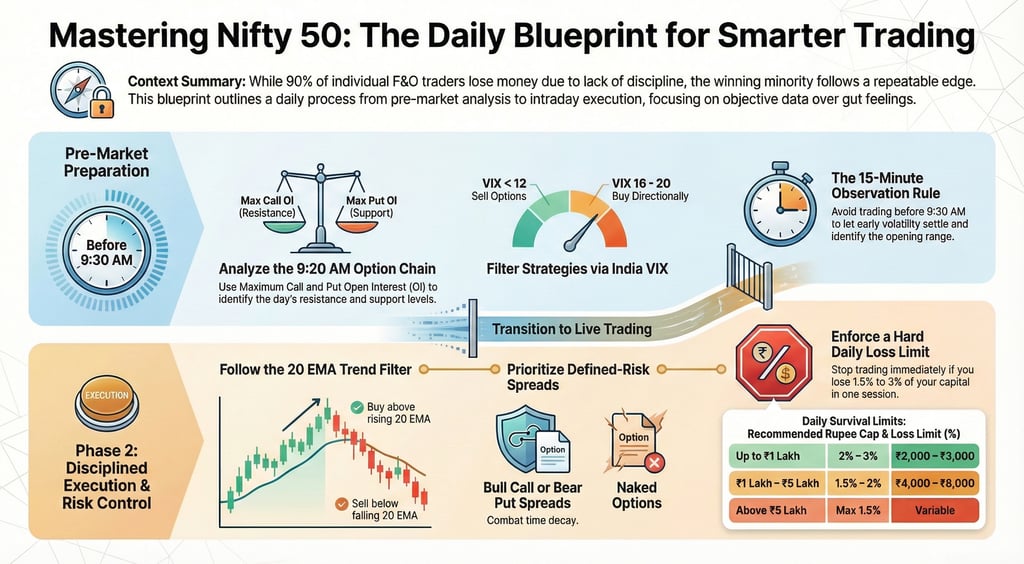
Maximum Call Open Interest (OI): This acts as immediate resistance. Nifty rarely closes above this level during expiry week. Treat it as a ceiling until proven otherwise.
Maximum Put Open Interest (OI): This acts as immediate support. Strong put writers typically defend this level. Treat it as a floor until breached with volume.
For example, if Calls have the highest OI at 22,500 and Puts have the highest OI at 22,000, the implied trading range for the week is 22,000 to 22,500. Trade within this range by selling spreads, or trade breakouts beyond these levels only with confirmed volume and momentum.
Pro Tip — Check the option chain at 9:20 AM — 5 minutes after market opens — rather than pre-market. Early OI often shifts in the first few minutes as big players adjust positions after the opening move.
Tip 2: Monitor India VIX Before Placing Any Options Trade
India VIX (Volatility Index) measures expected market volatility over the next 30 days. For Nifty options traders, this single number changes everything about your strategy selection. Here is a simple framework to apply every morning:
VIX below 12: Sell options or use Iron Condors to collect premium income. The market is calm and time decay works in the seller's favour.
VIX between 12 and 16: Use Bull or Bear spreads for defined-risk directional trades. ATM straddles can also work around major events.
VIX between 16 and 20: Buy options directionally. Elevated volatility gives options enough movement potential to overcome time decay.
VIX above 20: Reduce position size significantly and avoid naked short options. Sudden large moves can wipe out short premium positions in minutes.
Buying cheap OTM options when VIX is at 10 is a consistently losing strategy — time decay destroys value faster than the market can move in your favour. Match your strategy to the VIX environment every single day before entering a trade.
Tip 3: Respect Key Support and Resistance Levels Every Morning
Technical levels remain relevant because thousands of traders watch the same charts. This self-fulfilling dynamic makes support and resistance highly reliable for Nifty trading. Mark these three levels on your chart before 9:15 AM every day:
Previous Day High (PDH) and Previous Day Low (PDL): Breakouts from these levels on volume often signal the session's trend direction.
Previous Week High and Low: Respected as wider range boundaries, especially during consolidation phases.
Round Numbers such as 22,000, 22,500, and 23,000: Psychological levels where options are clustered. Expect reactions, reversals, or explosive breakouts at these zones.
A reliable morning routine: mark PDH, PDL, and the nearest round numbers on your 15-minute chart before 9:15 AM. These become your trade triggers for the session rather than reactive entries mid-move.
Tip 4: Trade With the Trend — Use the 20 EMA as Your Daily Compass
The 20-period Exponential Moving Average (EMA) on the 15-minute chart is one of the most reliable trend filters for intraday Nifty trading. The rule is straightforward and eliminates most premature entries:
Nifty trading above a rising 20 EMA: Look for buy setups only. Buy dips toward the EMA. Avoid puts and short trades.
Nifty trading below a falling 20 EMA: Look for sell or put setups only. Sell rallies toward the EMA. Avoid calls and long trades.
Nifty chopping around the 20 EMA without direction: Avoid directional trades entirely. Use range-bound strategies like Iron Condors or wait for a clear trend to develop.
This single filter eliminates the most common beginner mistake of buying calls in a downtrend and buying puts in an uptrend. The trend is the most powerful force in intraday markets — work with it, not against it.
Tip 5: Use Defined-Risk Strategies — Spreads Beat Naked Options for Most Traders
Buying naked calls or puts might seem simple, but your position is always in a race against time decay (theta). A far more capital-efficient approach for most traders is the vertical spread. Here is when to use each strategy type:
Bull Call Spread: Use when mildly bullish and VIX is low. Buy a lower strike call, sell a higher strike call. Your maximum loss is the net premium paid; your maximum reward is the strike difference minus that premium.
Bear Put Spread: Use when mildly bearish. Buy a higher strike put, sell a lower strike put. Same defined-risk structure as the Bull Call Spread but in the opposite direction.
Long Call or Put: Use when you have a strong directional conviction and are entering early in the expiry week (Monday or Tuesday). Maximum loss is limited to premium paid.
Iron Condor: Use in a sideways market when VIX is below 12. Sell both an OTM call spread and an OTM put spread simultaneously to collect premium if Nifty stays within a range.
Practical example: Nifty is at 22,300 and you are mildly bullish. Instead of buying a 22,300 CE at Rs 120 (Rs 9,000 outlay for 1 lot of 75), buy a 22,300/22,400 Bull Call Spread for Rs 50 net (Rs 3,750 outlay). Same directional bet, 58% less capital at risk, and a 100% return on investment if Nifty closes above 22,400 at expiry.
Tip 6: Set a Daily Loss Limit and Honor It Without Exception
This is the tip most traders know but few consistently follow. A daily loss limit is a hard cap on how much you are willing to lose in a single trading session — after which you stop trading entirely for that day. A reasonable framework:
Capital up to Rs 1 lakh: Daily loss limit of Rs 2,000 to Rs 3,000 (approximately 2 to 3 percent of capital).
Capital between Rs 1 lakh and Rs 5 lakh: Daily loss limit of Rs 4,000 to Rs 8,000 (approximately 1.5 to 2 percent of capital).
Capital above Rs 5 lakh: Daily loss limit should not exceed 1.5 percent of capital under any circumstances.
When you hit your daily limit, close everything and step away. No exceptions. The market will be there tomorrow. The compounding effect of avoiding large losing days is often more powerful than any single winning day.
Psychology Note — Most traders make their worst decisions after a loss — they become emotional and take revenge trades to recover quickly. The daily stop limit removes this option entirely, protecting both your capital and your decision-making clarity.
Tip 7: Avoid Trading the First 15 Minutes (9:15 to 9:30 AM)
The opening 15 minutes of Nifty trading are the most volatile and unpredictable of the entire session. Large overnight orders get executed, gap fills happen, and false breakouts are extremely common. Even experienced traders can be whipsawed badly in this window.
Instead, use the 9:15 to 9:30 AM window to observe and gather information:
Note whether Nifty opens gap up, gap down, or flat relative to the previous close
Observe whether the opening range (the high and low of the first 15-minute candle) is narrow or wide — a narrow range suggests controlled action, a wide range suggests early volatility
Check whether Nifty is moving toward PDH, PDL, or a key round number, which gives you a directional bias
Wait for the 9:30 AM candle to close, then make your first trade decision based on the opening range breakout direction or the emerging trend. This simple rule dramatically reduces premature entry losses for intraday traders.
Tip 8: Watch Global Markets — Gift Nifty, Dow Futures and Asian Indices Matter
Nifty does not trade in isolation. Before 9:15 AM, check these three indicators for a directional bias that shapes your morning strategy:
Gift Nifty (formerly SGX Nifty): Trades pre-market and is the single best real-time indicator of where Nifty will open. A premium above 50 points typically signals a gap-up; a discount below minus 50 points signals a gap-down.
US Market Close — Dow Jones, S&P 500, and Nasdaq: Strong positive or negative US sessions often set the tone for Indian markets, especially in IT-heavy and banking stocks that have global linkages.
Asian Markets — Nikkei and Hang Seng: If Asian markets are falling sharply by 9 AM IST, Nifty is likely to face early selling pressure. A strong Asian open provides positive momentum.
Important caveat: global cues give directional bias, not certainty. Nifty can and does diverge from global trends when domestic factors such as RBI policy announcements, corporate earnings, or political developments dominate the narrative. Use global data as a filter, not a mandate.
Tip 9: Understand Theta Decay — Never Hold Options Into Tuesday Expiry Blindly
Theta is the daily cost of holding an options contract. As expiry approaches, theta decay accelerates sharply — particularly in the final 24 hours before Tuesday expiry. Understanding this weekly rhythm is critical for Nifty options buyers:
Monday: Decay accelerates meaningfully. If your trade has not hit its target by end of Wednesday, exit the position and accept the partial loss.
Tuesday (Expiry Day): Theta decay is extremely fast in the final hours. Avoid buying options. Only experienced traders should sell or use spreads on expiry day.
Wednesday: Theta decay is slowest. This is the best time to buy options for a weekly directional trade with maximum time value remaining.
Thursday : Decay is slow to moderate. Enter directional trades only if you have a clear catalyst or strong technical setup.
The actionable rule: if you have bought a Nifty call or put and it has not hit your target by Monday at 3:00 PM, close the position. Do not hold into Tuesday hoping for a recovery — theta will accelerate the decline and the premium will erode rapidly regardless of market direction.
Tip 10: Maintain a Trading Journal — Your Most Underrated Edge
Every consistently profitable trader — equity, derivatives, or algorithmic — keeps a trading journal. It is the only personalised tool that improves your performance over time by revealing patterns in your own behaviour.
Your journal entry for each trade should include:
Date, time, and instrument traded (e.g., Nifty 22,300 CE, weekly expiry)
Your reason for entering — technical setup, option chain signal, news catalyst
Entry price, stop-loss level, and target price decided before entry
Exit price and the actual profit or loss outcome
One sentence on what you did well and one sentence on what you could have done differently
Review your journal at the end of each week. Within 30 to 40 trades, you will clearly identify your highest-probability setups to repeat more often, and your most common mistakes to eliminate. No paid tool or indicator provides this level of personalised insight.
The Nifty 50 Trader's Pre-Market Checklist
Use this checklist every morning before 9:15 AM. Save it as a note on your phone and run through it before every session:
Check Gift Nifty and note the premium or discount versus the previous Nifty close
Check India VIX and determine today's strategy type — buy options, sell options, or use spreads
Review the US market close — Dow Jones, S&P 500, and Nasdaq
Mark PDH and PDL on your 15-minute chart
Mark the nearest round numbers above and below the current Nifty level
Open the Nifty option chain and identify max Call OI (your resistance) and max Put OI (your support)
Note any major economic events scheduled for today — RBI statement, CPI data, US Fed minutes, major earnings
Set your daily loss limit for the session and write it down
Common Nifty Trading Mistakes to Avoid in 2026
Even experienced traders fall into these traps repeatedly. Awareness is the first step to avoidance:
Chasing the market: Entering a long trade after Nifty has already risen 100 points intraday. The easy money has been made by then. Wait for pullbacks to established levels rather than buying breakouts blindly.
Overusing leverage: F&O allows high leverage, but deploying it fully on every trade guarantees account blowups over time. Position size conservatively, especially when learning.
Ignoring macro events: Trading options the day before a US Fed meeting or RBI policy announcement without factoring in the event risk is a common and costly error. Reduce size or avoid entirely around scheduled events.
Holding losing intraday positions overnight: Nifty positions that have gone against you intraday should rarely be converted to overnight holds without a very deliberate reason and clear stop-loss.
Switching strategies mid-session: Decide your strategy for the day pre-market and stick with it. Switching from selling to buying (or vice versa) during volatile sessions based on fear creates compounding losses.
Nifty 50 Trading: Key Statistics for Realistic Expectations
Understanding baseline statistics helps you set realistic expectations and avoid the trap of chasing unrealistic returns:
Over 90% of individual F&O traders lose money over any 3-year period, according to SEBI's 2023 study
The average Nifty daily range in 2024 to 2025 was approximately 150 to 250 points
A typical ATM Nifty options premium during non-expiry week is Rs 80 to Rs 130 per unit, or Rs 6,000 to Rs 9,750 per lot
Recommended minimum capital for F&O trading with proper risk management is Rs 50,000 to Rs 1,00,000
A realistic monthly return for disciplined beginner traders after the learning phase is 4 to 8 percent
The Nifty 50 lot size as of 2026 is 75 units per lot
Frequently Asked Questions
What is the best time to trade Nifty 50 intraday?
The two most consistent windows are 9:30 to 11:00 AM, which is the morning trend establishment phase, and 1:30 to 3:00 PM, which is the afternoon momentum session. Avoid trading between 11:30 AM and 1:00 PM when Nifty often chops sideways on low volume, making directional trades unreliable.
How much capital do I need to start trading Nifty options?
A minimum of Rs 50,000 is recommended for meaningful risk management. One lot of an ATM Nifty option typically costs Rs 6,000 to Rs 10,000, meaning with Rs 50,000 you can comfortably manage two positions with a buffer for margin requirements and unexpected moves. Never deploy your full capital into a single position.
What is the difference between Nifty Futures and Nifty Options for a beginner?
Nifty Futures move almost exactly 1:1 with the Nifty index and require daily mark-to-market (MTM) margin payments. Your potential loss is theoretically unlimited. Nifty Options when purchased limit your loss to the premium paid, making them more beginner-friendly for learning directional trading. Start with option buying before moving to option selling or futures trading.
How do I use the Nifty option chain for trading decisions?
Focus on the Open Interest (OI) column. The strike with the highest Call OI is your resistance zone; the strike with the highest Put OI is your support zone. When Nifty approaches either level, watch for a reaction. A strong push through the max OI level with increasing volume is a breakout signal. Sideways action near the level suggests continued range-bound trading and favours spread strategies.
Is it safe to hold Nifty options overnight?
Holding Nifty options overnight carries gap risk — if global markets move significantly after the Indian market closes, Nifty can open with a large gap that moves sharply against your position. As a beginner, it is generally safer to close all option positions by 3:20 PM. Only hold overnight with a clear fundamental catalyst, a defined stop-loss, and appropriately small position sizing.
What is Gift Nifty and how should I use it?
Gift Nifty, formerly known as SGX Nifty, is a Nifty futures contract traded on the NSE International Exchange in GIFT City, Gujarat. It trades from early morning before the NSE opens and reflects global sentiment toward Indian markets. A Gift Nifty that is consistently rising in the morning typically indicates a positive opening for Nifty 50, and vice versa. Use it as a directional bias, not a guarantee.
How many trades should I take per day as a beginner?
For beginners, limit yourself to a maximum of 2 to 3 trades per day. More trades does not mean more profit — it usually means more transaction costs, more emotional decisions, and more losses. Focus on finding 1 or 2 high-quality setups each session and executing them with discipline rather than trading every market movement you see.
Conclusion: Build a Process, Not Just a Trade
The Nifty 50 offers India's most liquid, transparent, and well-studied trading market. The tips in this guide are not secrets — they are the foundational habits of every consistently profitable Nifty trader. The market does not reward those who trade the most; it rewards those who trade correctly, consistently, and with discipline.
Start with the pre-market checklist. Apply the daily loss limit without exception. Pick two or three strategies from this guide that match your risk tolerance and master them completely before adding more complexity. Track every trade in a journal and review it weekly.
The traders who succeed long-term in Nifty are not the ones who found a magic indicator — they are the ones who developed a repeatable process and followed it with discipline even on the bad days. nifty50today.com is here to give you the daily data, analysis, and context you need to make that process work.